UMH PhD Student Jesús Limens: “Everyone deserves some form of education or instruction in neuroethics like this”
12 September 2025
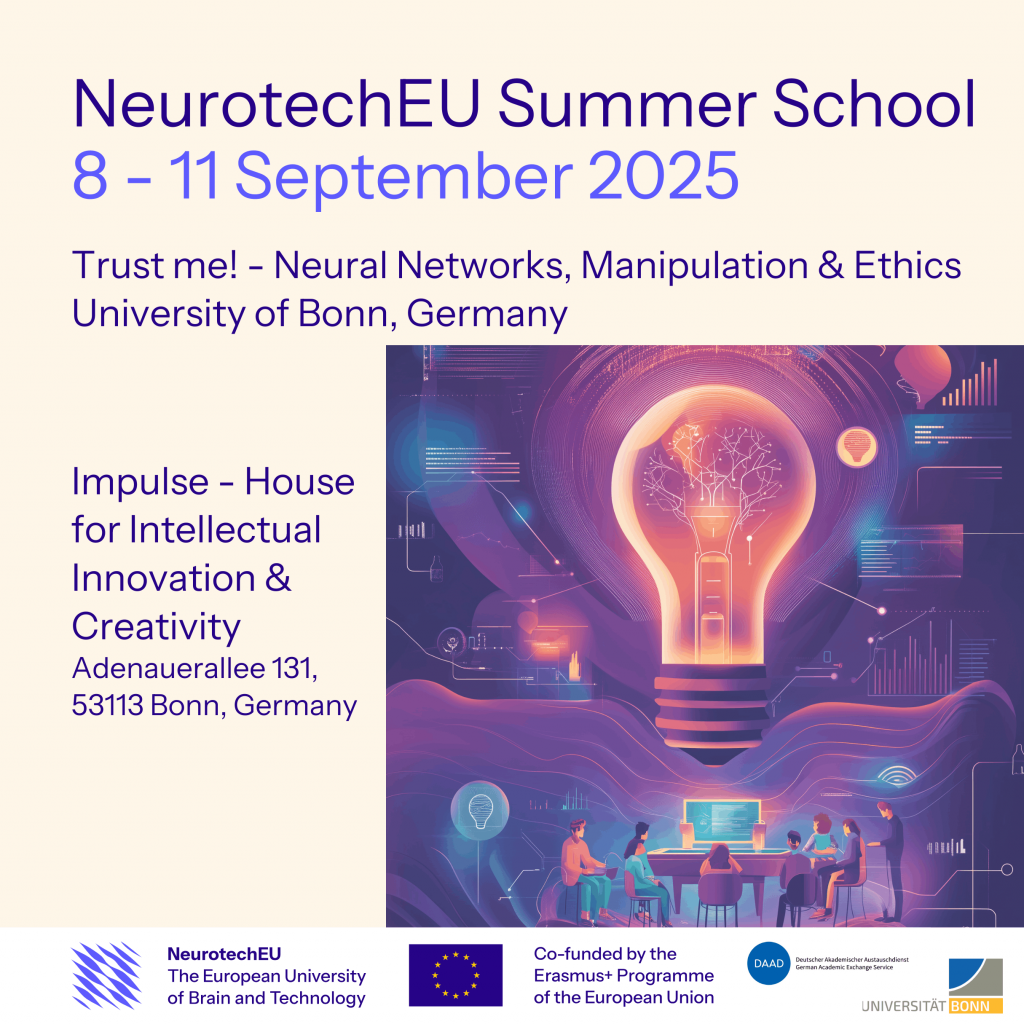 When science, technology, and the humanities meet, ethical and moral debates arise about how far we can and should go with scientific and technological advancements. These and other questions were tackled by Jesús Limens, a student on the Neurosciences Doctoral Programme, at the Summer School held at the University of Bonn titled Trust me! Neural Networks, Manipulation, and Ethics.
Limens is a PhD candidate who comes from the world of physics and now researches neuromodulation using ultrasound and non-invasive brain stimulation—an area of research where ethical and moral dilemmas are on the rise.
Jesús, why did you decide to apply for the place to attend this Summer School in Bonn?
A: Mainly because I thought it dealt with a topic that we don’t work on much here. And ultimately, directly or indirectly, every development or breakthrough made in science has an implication for a patient, and if we want to be correct and ethical, there are certain dilemmas we need to consider in advance.
Do you think the summer school met your expectations?
A: Yes, more than adequately. Above all, because I had never encountered certain topics that were discussed. I wouldn’t have even considered them. Furthermore, almost all attendees were humanities students, and it was very interesting to realise things that we see as very distant but are truly present.
For instance, there were three talks that revolved around manipulation—what it is, how it is defined, how it can occur, etc. At first, it seems like an isolated topic, introductory perhaps, but then comes the important part: if helmets are commercialised that stimulate the brain to help you, for example, to sleep, be more creative, or decide which route to take to get from one point to another, what happens when you have the brain activity of a population monitored, in addition to their location and everything else? The person who controls that data has all your information—not your cookies, but your very way of being—at their disposal. The risk of massive manipulation is much higher there.
You spoke of manipulation as one of the risks of certain technological advancements; were others discussed during the summer school?
A: Yes. There was also talk of the discrimination that can be caused by having or not having access to these resources that are developed, and, in turn, the resource gap between those who can afford them and those who cannot. That is to say, first there is the fact that one has it and the other doesn’t, but then, in addition, there is the fact of what the person who has it can do, which the one who doesn’t cannot.
And, after discussing these types of ethical and moral dilemmas, did you reach any kind of conclusion at any point?
A: A conclusion as such, no. But I would say that we left with a common opinion, which is that there are many opportunities with this technology, but many people there questioned the necessity of some of these advancements.
As someone dedicated to synaptic neuromodulation, I believe that promoting neurotechnology is not a problem. But it must be for a public good, even though public enterprise also poses a risk.
Jesús, how were all these debates and topics worked on?
A: All the days had a similar structure: in the mornings, we had up to three talks related to artificial intelligence, neurotechnology, and ethical and philosophical dilemmas. However, one of the things I would highlight most about the talks were the question rounds. A lot of people always asked questions, and even the least interesting talks ended up being very active.
Afterwards, we had group work. In fact, the theatrical representation I mentioned is part of an activity they called the ‘Ideathon,’ where each group had to propose the ethical and moral dilemmas related to an innovative neurotechnological device.
Finally, do you believe that these types of activities or training are necessary?
A: Completely. I believe that these types of activities address a part of science that we don’t fully confront. Furthermore, I consider that everyone deserves and should… look, I prefer the word deserve, some form of ethical education or instruction of this kind. I recommend and encourage people to train and learn about neuroethics.